

US Navy

Marine Species Monitoring
Atlantic passive acoustic baseline monitoring synthesis reports available
High-frequency Acoustic Recording Package (HARP) deployments were a key component of the original multi-disciplinary baseline monitoring effort in the Atlantic beginning in 2007 for Onslow Bay and continuing through 2022 for the Norfolk Canyon site. The primary objective of deployments at all locations was to determine patterns of species occurrence, compare distributional patterns across regions, and document species-specific vocalizations. In total there were 57 deployments across all study areas. This data archive has recently undergone a comprehensive re-analysis using standardized, state-of-the-art methods to ensure consistency and comparability of across sites. Details of the processing and synthesis of results are now available in a series of comprehensive technical reports.
These extensive datasets provide a crucial baseline for understanding the diverse marine mammal communities that inhabit these variable oceanographic settings, and how they interact with both natural soundscapes and human activities. The comprehensive re-analysis ensures consistent data quality, enabling robust future assessments of environmental change, anthropogenic impacts, and acoustic habitat use across the western North Atlantic. All data has been contributed to an ongoing broad analysis of North Atlantic shelf break species and multiple other collaborative studies, resulting in dozens of peer-reviewed publications and presentations at scientific conferences.
Summaries of individual HARP deployments can be found through the PAM data explorer. Links to the new synthesis reports are provided below.
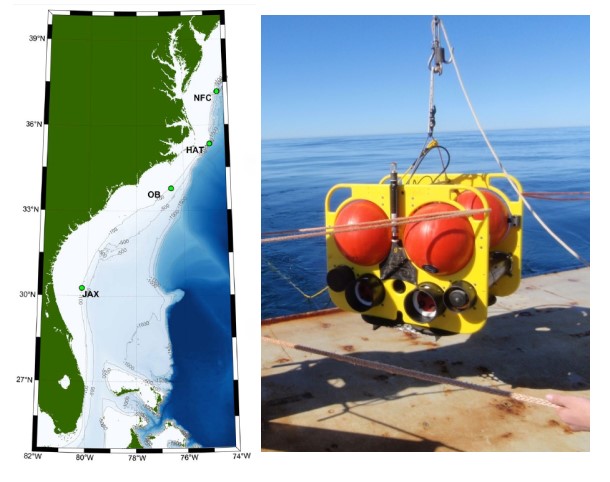
- Passive Acoustic Monitoring for Marine Mammals and Ambient Noise Near Norfolk Canyon
- Passive Acoustic Monitoring for Marine Mammals and Ambient Noise Offshore Cape Hatteras, NC
- Passive Acoustic Monitoring for Marine Mammals and Ambient Noise in Onslow Bay
- Passive Acoustic Monitoring for Marine Mammals and Ambient Noise in the Jacksonville Range Complex
- Passive Acoustic Monitoring of Anthropogenic Noise at Four Sites in the Western North Atlantic
Past news
New Publication - Long-term monitoring of Ziphius cavirostris behavior using 3D tracking from fixed hydrophone arrays off Southern California
New Publication - A Comparison of Diving Behavior of Goose-beaked Whales and Dense-beaked Whales From Tagging Studies in Multiple Ocean Basins
New Publication - Vessel strike encounter risk model informs mortality risk for endangered North Atlantic right whales along the United States east coast


