

US Navy

Marine Species Monitoring
First CEE Trial of 2026 – and False Killer Whales
The Atlantic BRS team had an extremely productive day on Friday, July 17th. The R/V Shearwater departed from Beaufort on the afternoon of the 16th and steamed overnight to the shelf break off Cape Hatteras. The tagging crew was on the R/V Barber, and transited from Oregon Inlet at first light on Friday morning. The two vessels met 40 nautical miles offshore of Cape Hatteras shortly after 9:00, with the Shearwater working a mixed group of pelagic bottlenose dolphins (Tursiops truncatus) and false killer whales (Pseudorca crassidens).
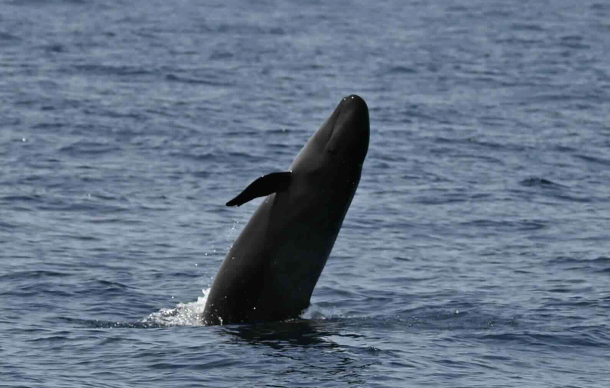
False killer whale breaching off Cape Hatteras. Photo by Andy Read.
We were particularly excited to see the false killer whales, because so little is known about this species in the western North Atlantic. We have seen them once before during surveys of the Jacksonville Shallow Water Training Range off Florida and our colleagues Kate Sutherland and Brian Patteson see them occasionally off Cape Hatteras on their pelagic seabird trips. We deployed two SPOT satellite-linked tags on the false killer whales – these are the first tags deployed on this species in the western North Atlantic. We are looking forward to monitoring the movements of these pelagic animals over the coming weeks and months.
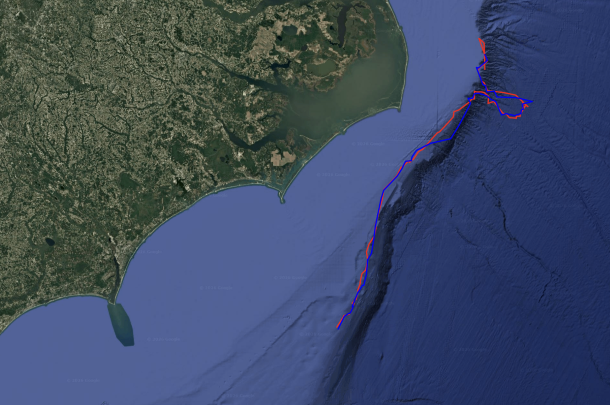
Movements of two false killer whales tagged on July 17th. The animals are moving from north to south and the last position is from July 21st. Map courtesy of Wildlife Computers.
It was a very hot day, but we had excellent sighting conditions in the Gulf Stream off Hatteras. Our two vessels encountered many groups of goose-beaked whales (Ziphius cavirostris) and we were able to deploy two additional satellite-linked SPLASH dive recorders on this species.
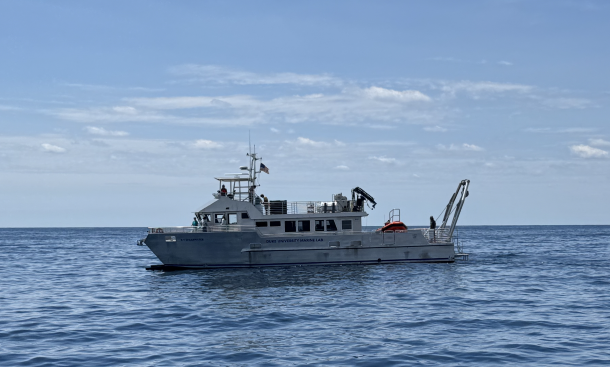
The R/V Shearwater off Cape Hatteras. Photo by Andy Read.
While we were tagging false killer and goose-beaked whales, the Shearwater crew was conducting a focal follow of ZcTag167, which we tagged on July 3rd. In the late afternoon, the Barber assumed the focal follow and the Shearwater prepared to deploy a custom-built sound source to conduct a Controlled Exposure Experimental trial with simulated Continuous Active Sonar signals. The 30-minute trial went perfectly and were able to maintain contact with ZcTag167 throughout the playback. The tagged whale appeared to respond by modifying its diving behavior and moving away from the sound source, as we have seen in other CEE trials with this species.
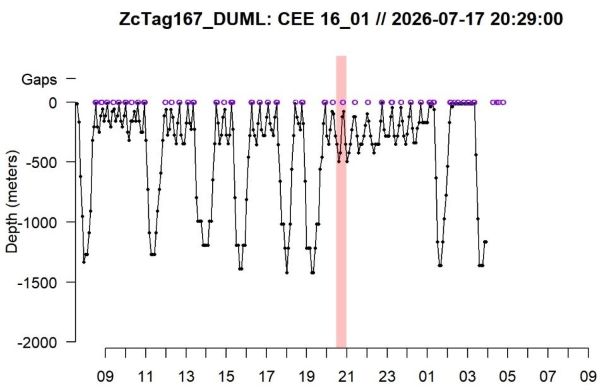
Dive profile of Dice profile of goose-beaked whale ZcTag167. The simulated Continuous Active Sonar signal is indicated in pink. Time is GMT. Image created by Will Cioffi.
The Barber passed the focal follow of ZcTag167 back to the Shearwater at 18:00 and started to make the 40-mile run back to shore. The Shearwater followed the animal for several hours, collecting dive and positional data, before heading back to Beaufort before a strong front moved through mid-day on Saturday. Many thanks to the science and ship’s crew on the Shearwater and the tagging crew on the Barber for their hard work on a sweltering day in the Gulf Stream.

